Blog: ASME STLLC’s Role in Shaping Tomorrow
Blog: ASME STLLC’s Role in Shaping Tomorrow

A look at two projects at ASME STLLC, whose mission is to provide new standards-related products and services to advance the application of emerging and newly commercialized science and technology.
In 2004, ASME formed ASME Standards Technology LLC (STLLC), which provides the research and technology development needed to maintain the technical relevance of ASME’s Codes and Standards.
ASME STLLC funds, oversees, and manages research projects that help support ASME’s codes and standards and the volunteer committees by providing the data needed to validate, update, or expand on what ASME’s codes and standards cover. At the end of projects, the data is delivered to the volunteers on the relevant committees, and generally a report is published that is available to the public in the form of a Standards Technology Publication (STP), Nuclear Technology Book (NTB), or Pressure Technology Book (PTB). Most of the projects STLLC engages in come from ASME’s volunteer committees, whose members propose and approve of the projects they think are needed to help support the committee, ASME, and industry in general.
STLLC currently has more than a dozen research projects running, but we would like to highlight two projects here that will support the understanding and applications of advanced materials.
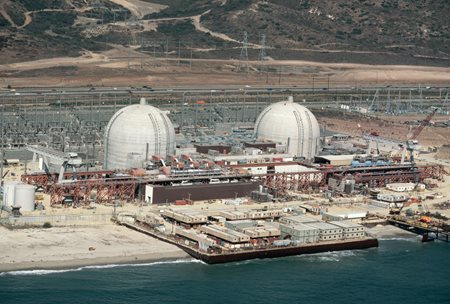 Photo: Getty
This research was undertaken to keep concrete containments relevant and economically viable. The nuclear industry in the United States has shifted away from concrete containment, due to delays and cost overruns, and toward steel containment vessels, despite being more expensive to build. If this research and further research like it can lay the groundwork to prove the use of UHPC to construct better concrete containments, it will greatly help advance safe, reliable, and affordable nuclear power, including applications for small modular reactors (SMRs) and microreactors.
Photo: Getty
This research was undertaken to keep concrete containments relevant and economically viable. The nuclear industry in the United States has shifted away from concrete containment, due to delays and cost overruns, and toward steel containment vessels, despite being more expensive to build. If this research and further research like it can lay the groundwork to prove the use of UHPC to construct better concrete containments, it will greatly help advance safe, reliable, and affordable nuclear power, including applications for small modular reactors (SMRs) and microreactors.
This work has resulted in multiple key conclusions:
This project finished in 2025 and the complete report on STP-NU-098 is available on the ASME website.
This project seeks to address this challenge by qualifying Arc Directed Energy Deposition (Arc-DED) for use in fabricating components operating in the time-dependent (creep) regime. Arc-DED is a wire-based additive manufacturing process that enables rapid fabrication of large builds with the benefit of uniform properties and reduced variability compared to conventional manufacturing methods. This project will gather and analyze existing data as well as generate new data for all-weld metal properties, primarily made up of ER90S-B91 (P91) weld metal tested at high temperature to justify extending the approval of arc DED material into the time-dependent regime. Data from low alloy steel filler metals ER80S-B3 (2-1/4 Cr- 1/2Mo) and ER80S-B2 (1-1/4Cr-1Mo) tests will also be collected where available.
 As part of a wire direct energy deposition (DED) convergent manufacturing demonstration, a 16-by-16-inch tee was printed from a starting 16-inch SCH 160 pipe to reduce the final printed weight by about 50 percent. Photo: EPRI
John Siefert and Pat Becker of the Electric Power Research Institute (EPRI) are leading the research, which is receiving significant contributions from Lincoln Electric Additive Solutions (LEAS), Product Evaluation Systems (PES), and Triaxis Power Consulting LLC. This effort is being leveraged with an additional ~$1 million in funding through a parallel industry sponsored supplemental project also led by EPRI (3002026036).
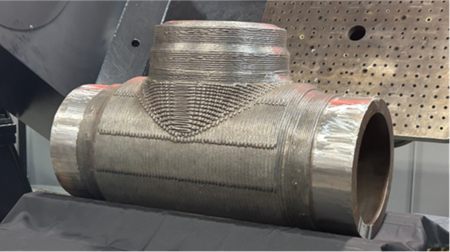
As part of a wire direct energy deposition (DED) convergent manufacturing demonstration, a 16-by-16-inch tee was printed from a starting 16-inch SCH 160 pipe to reduce the final printed weight by about 50 percent. Photo: EPRI
John Siefert and Pat Becker of the Electric Power Research Institute (EPRI) are leading the research, which is receiving significant contributions from Lincoln Electric Additive Solutions (LEAS), Product Evaluation Systems (PES), and Triaxis Power Consulting LLC. This effort is being leveraged with an additional ~$1 million in funding through a parallel industry sponsored supplemental project also led by EPRI (3002026036).
During Boiler Code Week in November 2025, several committees received updates on the project. Some of the milestones accomplished so far include development of material property databases for AWS type 91 and -B3/B3L filler metal, completion of ER90S-B91 wall builds, generation of time-independent data, and initiation of long-term creep tests.
Discover the Benefits of ASME Membership
To date, more than 30,000 hours of creep testing has been completed and additional tests are planned or ongoing. Preliminary results confirm tensile and yield strength requirements are met, charpy v-notch performance is acceptable, and the creep strength and ductility are proving to be sensitive to weld discontinuities. Demonstration articles, including small vessels and a full-scale steam tee (see first image above) will provide empirical data and are being utilized to assess structural performance.
Final reporting and recommendations are scheduled for mid-2026. Successful completion will enable ASME to establish design criteria for Arc-DED components in high-temperature service, potentially transforming supply chains, reducing lead times, and advancing the adoption of additive manufacturing in critical energy infrastructure.
The report and data will be made available to all relevant committees and will be published as an STP so all interested parties can purchase for a small fee. EPRI is co-authoring two papers with LEAS and will present the findings at the upcoming ASME PVP 2026 Conference in Anaheim, Calif. Future efforts to fill in the necessary gaps for AWS type -B3 are under consideration as a critical follow-on activity to address the performance of low alloy steels operating in the creep range.
Michael McKenna is project manager, research at ASME.
If you have an idea for any additional research topics, would like any more information on STLLC, or on our current and past research projects, including previously published STPs, please visit the STLLC website, or email us at research@asme.org. STLLC is always looking for additional research topic ideas from ASME’s members or the public. If you have an idea for a research topic that you think would be beneficial for ASME or industry in general to pursue, please email your idea to research@asme.org.
If you wish to support STLLC’s efforts and allow us to continue funding these types of important projects, please visit the ASME Foundation’s website to donate to the STLLC Research Projects Fund.
ASME STLLC funds, oversees, and manages research projects that help support ASME’s codes and standards and the volunteer committees by providing the data needed to validate, update, or expand on what ASME’s codes and standards cover. At the end of projects, the data is delivered to the volunteers on the relevant committees, and generally a report is published that is available to the public in the form of a Standards Technology Publication (STP), Nuclear Technology Book (NTB), or Pressure Technology Book (PTB). Most of the projects STLLC engages in come from ASME’s volunteer committees, whose members propose and approve of the projects they think are needed to help support the committee, ASME, and industry in general.
STLLC currently has more than a dozen research projects running, but we would like to highlight two projects here that will support the understanding and applications of advanced materials.
Project 197: Next Generation Concrete Containment Vessels
This project investigated the viability of ultra high-performance concrete (UHPC) and state-of-the-art single strand high-density polyethylene (HDPE) greased-sheathed tendons for use in concrete containment vessels for nuclear power reactors. Leading the project were Thomas Kang and Seung Heon Lee of the Department of Architecture and Architectural Engineering at Seoul National University, and Christopher Jones of the Department of Civil Engineering at Kansas State University, with oversight and input from the ASME Section III Division 2 / ACI 359 Joint committee on concrete containments.
Photo: Getty
This work has resulted in multiple key conclusions:
- The inclusion of steel fibers appears to increase the instantaneous stiffness (viz. Young’s Modulus) for UHPC mixtures in comparison to those without fibers.
- The creep behavior for UHPC mixtures containing fibers appears to be significantly less than for mixtures without fibers.
- The inclusion of fibers may slightly increase drying shrinkage; however, the effect is small and near the detection sensitivity of the instruments used in the study.
- The creep behavior of UHPC appears to be reduced by the presence of steel fibers in the mixture.
This project finished in 2025 and the complete report on STP-NU-098 is available on the ASME website.
Project 198: Extension of Arc DED into time-dependent regime for ASME BPVC
Large components that are traditionally manufactured from castings or forgings generally have long lead times. These delays can significantly impact plant availability, sometimes exceeding $1 million per day in lost revenue.This project seeks to address this challenge by qualifying Arc Directed Energy Deposition (Arc-DED) for use in fabricating components operating in the time-dependent (creep) regime. Arc-DED is a wire-based additive manufacturing process that enables rapid fabrication of large builds with the benefit of uniform properties and reduced variability compared to conventional manufacturing methods. This project will gather and analyze existing data as well as generate new data for all-weld metal properties, primarily made up of ER90S-B91 (P91) weld metal tested at high temperature to justify extending the approval of arc DED material into the time-dependent regime. Data from low alloy steel filler metals ER80S-B3 (2-1/4 Cr- 1/2Mo) and ER80S-B2 (1-1/4Cr-1Mo) tests will also be collected where available.
As part of a wire direct energy deposition (DED) convergent manufacturing demonstration, a 16-by-16-inch tee was printed from a starting 16-inch SCH 160 pipe to reduce the final printed weight by about 50 percent. Photo: EPRI
During Boiler Code Week in November 2025, several committees received updates on the project. Some of the milestones accomplished so far include development of material property databases for AWS type 91 and -B3/B3L filler metal, completion of ER90S-B91 wall builds, generation of time-independent data, and initiation of long-term creep tests.
Discover the Benefits of ASME Membership
To date, more than 30,000 hours of creep testing has been completed and additional tests are planned or ongoing. Preliminary results confirm tensile and yield strength requirements are met, charpy v-notch performance is acceptable, and the creep strength and ductility are proving to be sensitive to weld discontinuities. Demonstration articles, including small vessels and a full-scale steam tee (see first image above) will provide empirical data and are being utilized to assess structural performance.
Final reporting and recommendations are scheduled for mid-2026. Successful completion will enable ASME to establish design criteria for Arc-DED components in high-temperature service, potentially transforming supply chains, reducing lead times, and advancing the adoption of additive manufacturing in critical energy infrastructure.
The report and data will be made available to all relevant committees and will be published as an STP so all interested parties can purchase for a small fee. EPRI is co-authoring two papers with LEAS and will present the findings at the upcoming ASME PVP 2026 Conference in Anaheim, Calif. Future efforts to fill in the necessary gaps for AWS type -B3 are under consideration as a critical follow-on activity to address the performance of low alloy steels operating in the creep range.
Michael McKenna is project manager, research at ASME.
If you have an idea for any additional research topics, would like any more information on STLLC, or on our current and past research projects, including previously published STPs, please visit the STLLC website, or email us at research@asme.org. STLLC is always looking for additional research topic ideas from ASME’s members or the public. If you have an idea for a research topic that you think would be beneficial for ASME or industry in general to pursue, please email your idea to research@asme.org.
If you wish to support STLLC’s efforts and allow us to continue funding these types of important projects, please visit the ASME Foundation’s website to donate to the STLLC Research Projects Fund.
A look at two projects at ASME STLLC, whose mission is to provide new standards-related products and services to advance the application of emerging and newly commercialized science and technology.
Related Content

Jun 18, 2026
Superconductors Reimagined

Reimagined superconductors could deliver zero-resistance power under real-world conditions. The solution lies in the substrate.
Jun 11, 2026
When Training Matters Experienced Engineers Teach

Dan Tompkins on engineering training, boiler and pressure vessel expertise, lifelong learning, and why experience still matters.
May 12, 2026
The End of Brittle Solar


Flexible carbon nanotubes replace brittle ITO in perovskite solar cells, boosting durability, efficiency, and lowering costs for next generation renewables.
Apr 30, 2026
Engineers Scale Up Smart Ceramic Composites


Researchers scaled smart ceramics by embedding shape memory particles in ductile metal, creating a tough composite that keeps the transformation effect.