Steam Locomotive Rededication Speaks to its Significance
Steam Locomotive Rededication Speaks to its Significance
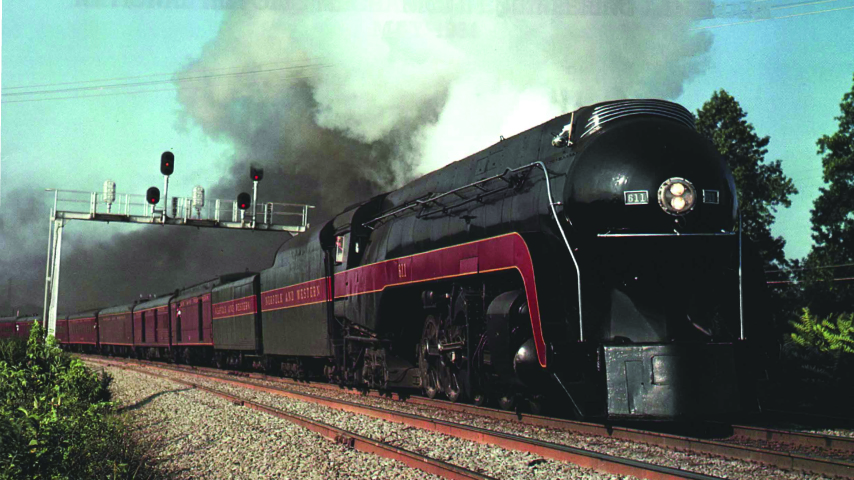
The #611 Class J Steam Locomotive engine, the last U.S. coal-fired passenger locomotives, was recently rededicated, 41 years after its original designation as a ASME Landmark in 1984.
A few ASME National Historic Mechanical Engineering Landmarks have been completely forgotten, some garner a crazy amount of attention, and then there are those that are just completely beloved. The Norfolk & Western #611 Class J Steam Locomotive is in the last category and nowhere is this more evident as when this coal-fired passenger locomotive was rededicated 41 years after its original designation as a ASME Landmark in 1984.
Developed for use in both the plains and mountains, “the locomotive was among the most advanced in design, construction, and performance of any 4-8-4,” explained Joseph Radisek. Addressing the strong, emotive effect of the powerful engine, the ASME volunteer and engineer acknowledged the allure of the #611. He explained that the wonder of the train ride is not necessarily just nostalgic, but an experience that means not “having the phone out, not having a destination per se, but just enjoying the journey.”
Even when they were building these engines in the 50s, Radisek said, people were asking, “Why are you building a steam engine? We already have diesel and diesel’s better.” And despite this, engineers took the time to make something that they could take pride in. And here we are and “the #611 is still here, it’s still taking passengers, and the heart and passion is built into it,” he explained.
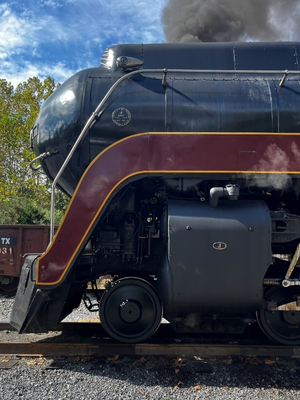 The #611 Class J Steam Locomotive engine. Photo: Joseph Radisek
Zac McGinnis, steam operations manager at the Virginia Museum of Transportation has been working with and around the #611 since 2014. “There’s something about these locomotives that captures people in a way few machines can,” he explained. “The Class J locomotives combine engineering excellence with artistic beauty with the streamline design, the sheer presence, the sound, the motion. They represent the pinnacle of American steam development, and people connect with them because they symbolize pride, craftsmanship, innovation, and a time when engineering was as much an art form as it was a science.”
The #611 Class J Steam Locomotive engine. Photo: Joseph Radisek
Zac McGinnis, steam operations manager at the Virginia Museum of Transportation has been working with and around the #611 since 2014. “There’s something about these locomotives that captures people in a way few machines can,” he explained. “The Class J locomotives combine engineering excellence with artistic beauty with the streamline design, the sheer presence, the sound, the motion. They represent the pinnacle of American steam development, and people connect with them because they symbolize pride, craftsmanship, innovation, and a time when engineering was as much an art form as it was a science.”
The steam engine’s appeal also lives in the ability of individuals to understand the technology, and it can be a very “tactile” experience, Radisek said and added, the engine happens to be something mechanics can understand. Designed by Norfolk & Western (N&W) Railways and built in the N&W Roanoke shops, the #611 was the sole survivor of 14 class “J” steam locomotives designed by mechanical engineers and built between 1941 and 1950.
For 18 years the Js ran almost three million miles each before retirement. Known for their performance and reliability, they were able to operate 15,000 miles per month. With an initial cost of $251,544, the #611 was placed in service on May 29, 1950. Six short years later, on January 23, 1956, the steam locomotive derailed on a wide curve near Cedar, W.Va. Because of the extensive repairs that followed the accident, the #611 was in good condition when the Js were retired in January 1959.
This single example exemplified the highest achievements in steam locomotive engineering and was why Roanoke Chapter of the National Railway Historical Society requested one engine to operate a passenger excursion. This act saved the #611 from the scrap yard. It was restored to mint condition and steamed into Roanoke in August 1982 to its final home to the city’s museum of transportation. The rebuild was a gift from the N&W in honor of the city of Roanoke’s 100th birthday.
 McGinnis pointed out that the N&W designed these locomotives to “handle their premier passenger trains from Norfolk to Cincinnati.” That meant the machine could handle 90–100 mph speeds through the flatlands of Virginia, and 40–50 mph through the mountains of western Virginia and West Virginia.
“N&W engineers perfected the science of balancing: precise counterweights on the drivers, Timken lightweight rods, and incredibly refined running gear. That’s why a locomotive with 70-inch drivers could safely run in the 100-mph range,” McGinnis said. “No other steam locomotive design has matched that. The fastest documented Class J hit 110 mph, an incredible achievement for a 4-8-4 built entirely with slide rules, pencils, and engineering intuition.”
Radisek explained that it may be hard to imagine an engine “that can go up the hills that it would need to get to the flatlands, and then once it gets into the flatlands, go for speed” all while giving passengers a smooth ride. And for the operators at the front, they had a well-designed system that was planned intuitively, “so that even in the dark of night, they could focus looking outward, and they knew, just from the handle shape, whether it was something that was going to speed them up, slow them down, or help them make a turn.”
At the end of September of this year dozens of people gathered at a small, wooden train station in Goshen, Va. The owner of the #611, now called the Virginia Museum of Transportation (VMT), joined ASME to rededicate the locomotive by unveiling a new plaque on its coal car. The new inscription replaced the 1984 plaque and helped commemorate the 75th anniversary of the locomotive’s build.
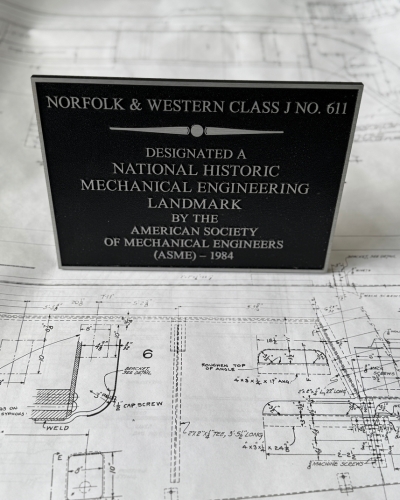 Rededication plaque. Photo: Zac McGinnis
“We’re proud… to be the curator of the world’s finest steam locomotive, as rededicated today,” Tom Cox, VMT board of directors said at the event reported The News-Gazette. “It’s a testimony to the grit and determination, knowledge, and ability of a lot of men and women, even before the age of computers.” These people “know it, they live it, they breathe it, and they want to show it,” Radisek said of the VMT #611 mechanical crew that ensured the locomotive was ready for weekend passenger excursions throughout the Shenandoah Valley this fall. This service includes expertise that addresses the need for hands-on repair work when needed.
Rededication plaque. Photo: Zac McGinnis
“We’re proud… to be the curator of the world’s finest steam locomotive, as rededicated today,” Tom Cox, VMT board of directors said at the event reported The News-Gazette. “It’s a testimony to the grit and determination, knowledge, and ability of a lot of men and women, even before the age of computers.” These people “know it, they live it, they breathe it, and they want to show it,” Radisek said of the VMT #611 mechanical crew that ensured the locomotive was ready for weekend passenger excursions throughout the Shenandoah Valley this fall. This service includes expertise that addresses the need for hands-on repair work when needed.
“People come from all over the world to ride behind #611,” McGinnis added. “For many, it’s a once-in-a-lifetime experience. We’re incredibly proud at the Virginia Museum of Transportation to share the #611 not only as a living piece of history, but as a platform to teach engineering, steam technology, and the craftsmanship that built these machines. And of course, the scenery through Goshen and the Shenandoah Valley with its rolling hills, forests, and open fields is simply the icing on the cake.”
What most people can take away from these giants of their age is that “the steam locomotive is one of the greatest inventions in human history. In roughly 100 years, we went from small wood-burning engines that topped out around 20 mph to powerful coal-burning locomotives generating over 5,000 horsepower and running 100 mph,” McGinnis said. “They linked the nation, carried its people, moved freight, and powered the country through two world wars—all by boiling water.”
He added, “What amazes people today is realizing these engines were designed entirely with pencil, paper, protractors, and slide rules. There were no computers, no CAD, no CNC machines. They were built to last, and many still run today more than a century later. They are monuments to American engineering.”
Cathy Cecere is membership content program manager.
Developed for use in both the plains and mountains, “the locomotive was among the most advanced in design, construction, and performance of any 4-8-4,” explained Joseph Radisek. Addressing the strong, emotive effect of the powerful engine, the ASME volunteer and engineer acknowledged the allure of the #611. He explained that the wonder of the train ride is not necessarily just nostalgic, but an experience that means not “having the phone out, not having a destination per se, but just enjoying the journey.”
History to look back on
Even when they were building these engines in the 50s, Radisek said, people were asking, “Why are you building a steam engine? We already have diesel and diesel’s better.” And despite this, engineers took the time to make something that they could take pride in. And here we are and “the #611 is still here, it’s still taking passengers, and the heart and passion is built into it,” he explained.
The #611 Class J Steam Locomotive engine. Photo: Joseph Radisek
The steam engine’s appeal also lives in the ability of individuals to understand the technology, and it can be a very “tactile” experience, Radisek said and added, the engine happens to be something mechanics can understand. Designed by Norfolk & Western (N&W) Railways and built in the N&W Roanoke shops, the #611 was the sole survivor of 14 class “J” steam locomotives designed by mechanical engineers and built between 1941 and 1950.
For 18 years the Js ran almost three million miles each before retirement. Known for their performance and reliability, they were able to operate 15,000 miles per month. With an initial cost of $251,544, the #611 was placed in service on May 29, 1950. Six short years later, on January 23, 1956, the steam locomotive derailed on a wide curve near Cedar, W.Va. Because of the extensive repairs that followed the accident, the #611 was in good condition when the Js were retired in January 1959.
This single example exemplified the highest achievements in steam locomotive engineering and was why Roanoke Chapter of the National Railway Historical Society requested one engine to operate a passenger excursion. This act saved the #611 from the scrap yard. It was restored to mint condition and steamed into Roanoke in August 1982 to its final home to the city’s museum of transportation. The rebuild was a gift from the N&W in honor of the city of Roanoke’s 100th birthday.
Today, the #611 only pulls special excursion trains. Eleventh of 14 constructed and the last survivor, this fighting spirit is understandable to many who take the time to appreciate the iconic engine and what it “takes to get it moving,” Radisek said. The #611 “represents the very height of modern steam engineering,” McGinnis added. In 1950, it “was one of the most advanced steam locomotives ever produced—fully streamlined, equipped with all roller bearings, pressure-fed lubrication, and designed for both immense power and sustained high speed. The Class J’s reliability was second to none.”
Engineering The Subway That Built a City
The Interborough Rapid Transit System made it possible for Manhattan to expand, outer boroughs to thrive, and New York City to grow into the modern metropolis it is today.
“N&W engineers perfected the science of balancing: precise counterweights on the drivers, Timken lightweight rods, and incredibly refined running gear. That’s why a locomotive with 70-inch drivers could safely run in the 100-mph range,” McGinnis said. “No other steam locomotive design has matched that. The fastest documented Class J hit 110 mph, an incredible achievement for a 4-8-4 built entirely with slide rules, pencils, and engineering intuition.”
Radisek explained that it may be hard to imagine an engine “that can go up the hills that it would need to get to the flatlands, and then once it gets into the flatlands, go for speed” all while giving passengers a smooth ride. And for the operators at the front, they had a well-designed system that was planned intuitively, “so that even in the dark of night, they could focus looking outward, and they knew, just from the handle shape, whether it was something that was going to speed them up, slow them down, or help them make a turn.”
Rededicated in 2025
At the end of September of this year dozens of people gathered at a small, wooden train station in Goshen, Va. The owner of the #611, now called the Virginia Museum of Transportation (VMT), joined ASME to rededicate the locomotive by unveiling a new plaque on its coal car. The new inscription replaced the 1984 plaque and helped commemorate the 75th anniversary of the locomotive’s build.
Rededication plaque. Photo: Zac McGinnis
“People come from all over the world to ride behind #611,” McGinnis added. “For many, it’s a once-in-a-lifetime experience. We’re incredibly proud at the Virginia Museum of Transportation to share the #611 not only as a living piece of history, but as a platform to teach engineering, steam technology, and the craftsmanship that built these machines. And of course, the scenery through Goshen and the Shenandoah Valley with its rolling hills, forests, and open fields is simply the icing on the cake.”
What most people can take away from these giants of their age is that “the steam locomotive is one of the greatest inventions in human history. In roughly 100 years, we went from small wood-burning engines that topped out around 20 mph to powerful coal-burning locomotives generating over 5,000 horsepower and running 100 mph,” McGinnis said. “They linked the nation, carried its people, moved freight, and powered the country through two world wars—all by boiling water.”
He added, “What amazes people today is realizing these engines were designed entirely with pencil, paper, protractors, and slide rules. There were no computers, no CAD, no CNC machines. They were built to last, and many still run today more than a century later. They are monuments to American engineering.”
Cathy Cecere is membership content program manager.
The #611 Class J Steam Locomotive engine, the last U.S. coal-fired passenger locomotives, was recently rededicated, 41 years after its original designation as a ASME Landmark in 1984.

Membership content program manager for ASME
Related Content

Jun 30, 2026
Engineering Chattanooga’s 130-Year-Old Incline Railway
Chattanooga’s Lookout Mountain Incline Railway, a funicular and ASME mechanical engineering landmark, has carried riders up a 72.7 percent grade for 130 years.

Jun 12, 2026
Quiz: A Trolley’s Trucks and Frogs

Although streetcars are more of a novelty these days, innovative engineering made them possible. See what you know with this ASME quiz.

Apr 27, 2026
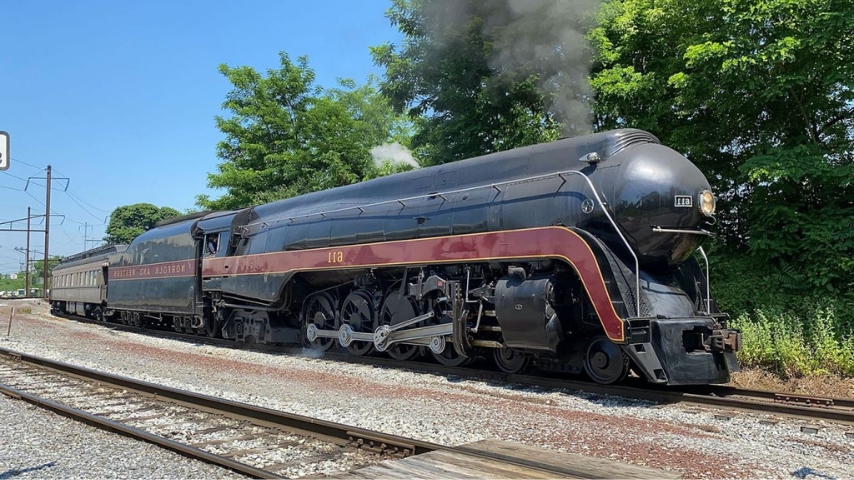
Podcast: The Enduring Legacy of Class J No. 611

Mar 11, 2026
Blog: Snow Removal from Streets and Space
From city streets to Arctic shipping lanes, engineers deploy innovative tools and technology to manage the challenges of snow and ice.