Sound on Mars?
Sound on Mars?
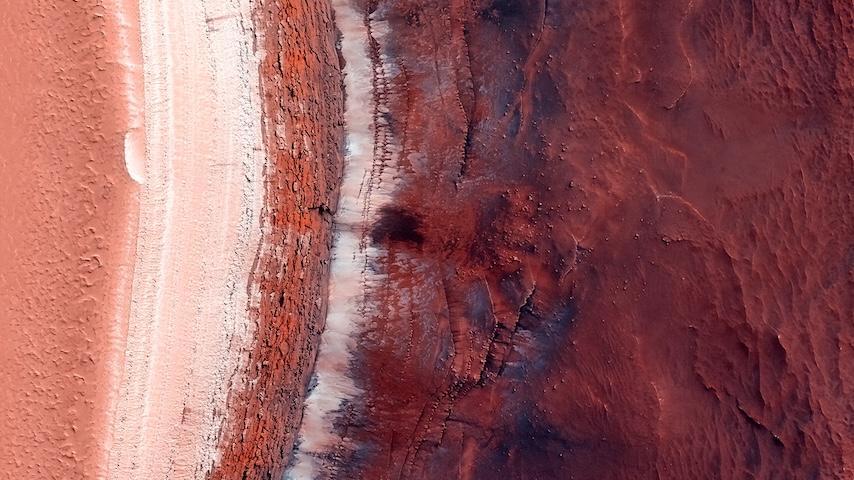
Researchers are modeling how the red planet’s conditions affect sound. The answers might help future missions.
Carrying out safe missions on Mars depends on a wide range of variables, such as temperature and weather patterns. But traditional measurements of these parameters can be a challenge. Optical cameras and thermal sensors might not always survive the harsh conditions on the red planet—average temperatures are around -63 ºC.
That’s where acoustic sensors come in. While dust or unreliable lighting conditions might adversely affect optical sensors, microphones can work in harsh and rugged planetary environments and are relatively simple and robust. In addition, it’s easier to gather acoustic data at high rates, so they can provide more detailed data on atmospheric dynamics, sometimes at higher time-space resolution than conventional meteorological sensors.
And understanding how sound moves on Mars might guide future exploration of the planet as well. It’s the thesis that drives the research of doctoral candidate Hayden Baird under the advisement of Zhongquan Charlie Zheng, professor and department head of Mechanical and Aerospace Engineering at Utah State University.
More for You: Rock Abrasion Tool for Mars Exploration
Routine atmospheric events such as turbulence, wind shear, and dust storms carry unique acoustic signatures. Acoustic sensors can then capture pressure fluctuations caused by turbulence and frequency shifts produced by moving air masses.
When a sound wave hits the ground or a hill, part of it reflects and part of it is absorbed. The pattern of reflections and interference depends on surface roughness, soil composition (sand, rock, porous material), and terrain geometry.
By analyzing the behavior of sound waves and the extent of their interference after reflection, researchers can reverse engineer information about the surface material and landscape.
As promising as acoustics might be in the study of Mars, researchers also need to understand how sound moves on the planet before acoustic equipment can serve as proxies for other kinds of sensors.
To do so, Baird and Zheng have developed an in-house developed acoustic simulation program. They are modeling the effects of various parameters such as terrain, soil porosity, wind, and temperature on acoustic wave propagation on Mars.
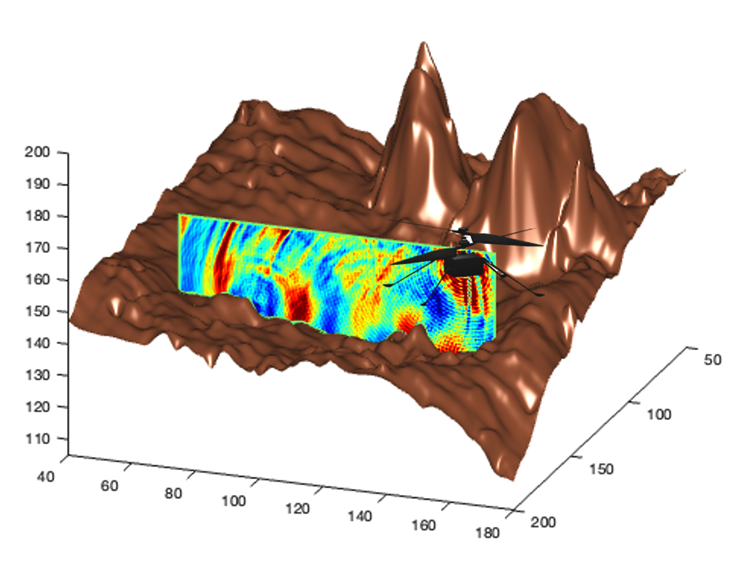 An illustration of the acoustic simulation conducted. The particular sound source in this picture was to mimic the Martian drone. The terrain in the simulation is a section of the real Martian terrain. Image: Zhongquan Zheng, Utah State University
These models are based on fluid-dynamics equations (Navier-Stokes equations) and include parameters such as atmospheric pressure and temperature, turbulence levels, terrain geometry, and the material properties of the planet’s surface.
An illustration of the acoustic simulation conducted. The particular sound source in this picture was to mimic the Martian drone. The terrain in the simulation is a section of the real Martian terrain. Image: Zhongquan Zheng, Utah State University
These models are based on fluid-dynamics equations (Navier-Stokes equations) and include parameters such as atmospheric pressure and temperature, turbulence levels, terrain geometry, and the material properties of the planet’s surface.
The current goal is to evaluate destructive interference patterns as sound moves through the surface of Mars. By comparing real acoustic measurements with simulation outputs, Baird hopes to determine which environmental parameters most likely produced the observed signal.
“There are many factors that [can create interference patterns], so how do you know which one is contributing what effect? Is this from wind shear of turbulence level or material and terrain properties? That’s why we conduct numerous simulations to evaluate the sensitivity and variation of each factor and how it influences the behavior of the acoustic signal,” Zheng said.
Discover the Benefits of ASME Membership
Baird and Zheng’s modeling work uses NASA’s published measurements of the atmospheric conditions and terrain on Mars, most of which are at meter-scale resolutions. The team also studied decades of data about other factors that influence sound propagation. These include the planet’s atmospheric composition and properties, as well as ground porosity.
The team is testing simulation results against the rich lode of data from the Jezero crater, the 2021 landing and exploration site of NASA’s Perseverance rover and its attached Ingenuity helicopter, which conducted many acoustic measurements. In addition, maps of the crater gave estimates of terrain geometry.
“As a result, we could start to tune our simulation based on realistic results. It’s a nice back and forth between experimental and simulation work,” Baird said.
In preliminary results, the team found differences in the time variation of destructive patterns for moving sources. A hill causes one kind of pattern, for example, which can be used to infer the location and relative motion of the source. Differences in destructive patterns emerge when atmospheric conditions or terrain geometry change.
These simulations are in the space-time domain, which allows for direct implementation of complex source motion and behaviors. This could include changes in atmospheric turbulence or drone flight paths.
While simulating sound wave movement on Mars is not easy, it offers a critical step in understanding how to plan future missions not just to the planet but to other planets and moons, Baird said.
Poornima Apte is a technology writer based in Walpole, Mass.
That’s where acoustic sensors come in. While dust or unreliable lighting conditions might adversely affect optical sensors, microphones can work in harsh and rugged planetary environments and are relatively simple and robust. In addition, it’s easier to gather acoustic data at high rates, so they can provide more detailed data on atmospheric dynamics, sometimes at higher time-space resolution than conventional meteorological sensors.
And understanding how sound moves on Mars might guide future exploration of the planet as well. It’s the thesis that drives the research of doctoral candidate Hayden Baird under the advisement of Zhongquan Charlie Zheng, professor and department head of Mechanical and Aerospace Engineering at Utah State University.
More for You: Rock Abrasion Tool for Mars Exploration
Routine atmospheric events such as turbulence, wind shear, and dust storms carry unique acoustic signatures. Acoustic sensors can then capture pressure fluctuations caused by turbulence and frequency shifts produced by moving air masses.
When a sound wave hits the ground or a hill, part of it reflects and part of it is absorbed. The pattern of reflections and interference depends on surface roughness, soil composition (sand, rock, porous material), and terrain geometry.
By analyzing the behavior of sound waves and the extent of their interference after reflection, researchers can reverse engineer information about the surface material and landscape.
Modeling sound wave effects
As promising as acoustics might be in the study of Mars, researchers also need to understand how sound moves on the planet before acoustic equipment can serve as proxies for other kinds of sensors.
To do so, Baird and Zheng have developed an in-house developed acoustic simulation program. They are modeling the effects of various parameters such as terrain, soil porosity, wind, and temperature on acoustic wave propagation on Mars.
An illustration of the acoustic simulation conducted. The particular sound source in this picture was to mimic the Martian drone. The terrain in the simulation is a section of the real Martian terrain. Image: Zhongquan Zheng, Utah State University
The current goal is to evaluate destructive interference patterns as sound moves through the surface of Mars. By comparing real acoustic measurements with simulation outputs, Baird hopes to determine which environmental parameters most likely produced the observed signal.
“There are many factors that [can create interference patterns], so how do you know which one is contributing what effect? Is this from wind shear of turbulence level or material and terrain properties? That’s why we conduct numerous simulations to evaluate the sensitivity and variation of each factor and how it influences the behavior of the acoustic signal,” Zheng said.
Discover the Benefits of ASME Membership
Baird and Zheng’s modeling work uses NASA’s published measurements of the atmospheric conditions and terrain on Mars, most of which are at meter-scale resolutions. The team also studied decades of data about other factors that influence sound propagation. These include the planet’s atmospheric composition and properties, as well as ground porosity.
The team is testing simulation results against the rich lode of data from the Jezero crater, the 2021 landing and exploration site of NASA’s Perseverance rover and its attached Ingenuity helicopter, which conducted many acoustic measurements. In addition, maps of the crater gave estimates of terrain geometry.
“As a result, we could start to tune our simulation based on realistic results. It’s a nice back and forth between experimental and simulation work,” Baird said.
What’s next
In preliminary results, the team found differences in the time variation of destructive patterns for moving sources. A hill causes one kind of pattern, for example, which can be used to infer the location and relative motion of the source. Differences in destructive patterns emerge when atmospheric conditions or terrain geometry change.
These simulations are in the space-time domain, which allows for direct implementation of complex source motion and behaviors. This could include changes in atmospheric turbulence or drone flight paths.
While simulating sound wave movement on Mars is not easy, it offers a critical step in understanding how to plan future missions not just to the planet but to other planets and moons, Baird said.
Poornima Apte is a technology writer based in Walpole, Mass.
Researchers are modeling how the red planet’s conditions affect sound. The answers might help future missions.

Technology writer
Related Content

Jul 15, 2026
Water Barrier Seeks to Protect Sailors from Jet Noise

Researchers are testing water barriers as a way to reduce the dangerous jet noise levels naval personnel experience while working on aircraft carriers.
Jun 29, 2026
A Device to Tune In or Out
How humans speak, by taking turns, forms the basis for automated AI-driven proactive hearing assistance.

Mar 20, 2026
Quiz: Mechanisms Behind the Music

Up to facing the music? Test your instrument knowledge with this ASME quiz.
Nov 18, 2025
A Surface Slicker Than Ice