How Batavia and Its Windmills Helped Settle the American West
How Batavia and Its Windmills Helped Settle the American West
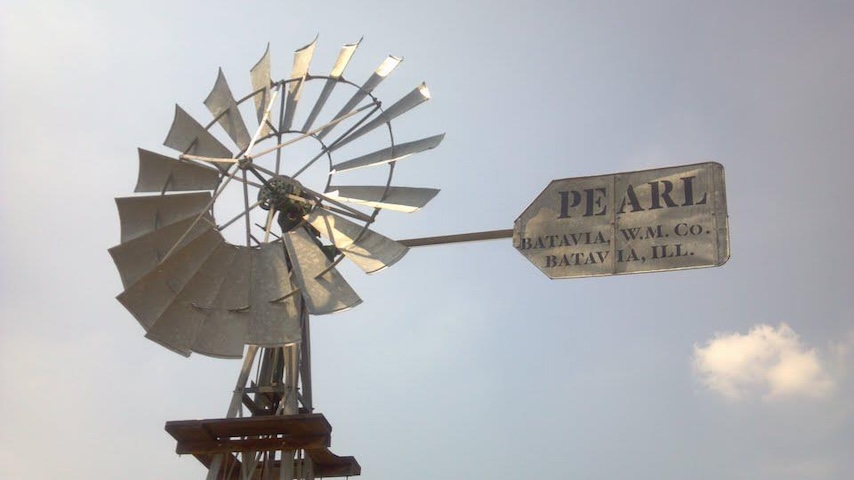
Six companies in Batavia, Ill., built the windmills that pumped water for the American West. A collection of 17 restored windmills is a Historic Mechanical Engineering Landmark.
The windmill is an icon of Americana. This charming fixture, which shows up frequently in art and literature, played a key role in America’s ability to settle the West in the 19th and 20th centuries.
And a big part of the American windmill story took place in the small Illinois town of Batavia. A western suburb of Chicago with a current population of about 26,000, Batavia adopted the nickname “Windmill City” because it was home to six windmill manufacturing companies from the 1860s to the 1950s.
Today, Batavia visitors can see a collection of the windmills that were built there. They are displayed near the Batavia Government Center and along the Fox River. As part of a community project initiated by the late Bob Popeck in 1994, 17 windmills were brought back to Batavia and restored to create the display. This windmill collection was named an ASME Historic Mechanical Engineering Landmark in September 2013.
Connecticut native Daniel Halladay was a leader in the advancement of windmills. His patented invention of the self-regulating wind engine in 1854 revolutionized the industry and inspired the launch of many windmill companies.
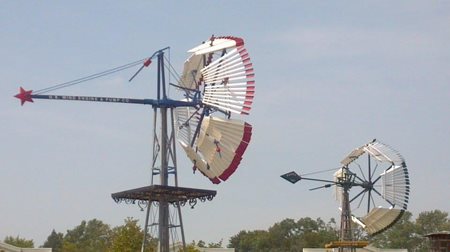 The Halladay Vaneless was manufactured by the U.S. Wind Engine and Pump Company from 1880 to 1890. The Challenge Vaneless model 1913 was manufactured in 1913 by the Challenge Company. Photo: BataviaHistory.org
Halladay was a founder of the U.S. Wind Engine & Pump Company (USWE), the nation’s first mass-production windmill factory, which opened in Batavia in 1857. Halladay and others started windmill factories in Batavia because it was a good location for manufacturing and distributing their products to the midwestern and western parts of the country.
The Halladay Vaneless was manufactured by the U.S. Wind Engine and Pump Company from 1880 to 1890. The Challenge Vaneless model 1913 was manufactured in 1913 by the Challenge Company. Photo: BataviaHistory.org
Halladay was a founder of the U.S. Wind Engine & Pump Company (USWE), the nation’s first mass-production windmill factory, which opened in Batavia in 1857. Halladay and others started windmill factories in Batavia because it was a good location for manufacturing and distributing their products to the midwestern and western parts of the country.
In the years after USWE set up shop, five other windmill manufacturers of various sizes opened in Batavia. The major ones were USWE, Challenge Wind Mill & Feed Mill Company, and Appleton Manufacturing Company. The three smaller companies were Batavia Wind Mill Company, Snow Manufacturing Company, and Danforth Windmill Company. By 1951, all the companies had closed, as electric water pumps had largely replaced windmill water pumps by that time.
But in the 1880s, Halladay’s self-regulating windmills could be seen on farms all over the Midwest and the West, where the technology was used to pump water for livestock, crops, and more. They were also popping up along railroad tracks, where water towers and windmills were needed about every 20 miles to refill the water tanks of steam locomotives.
More for You: The Old Mill Grinds On
“Self-regulating” meant the windmill would automatically turn its four variable-pitch blades away from a strong wind, rather than spinning so fast that centrifugal acceleration would destroy it. “The ingenious mechanical design of the wind-engine system of gears and linkages made efficient use of centrifugal and gravitational forces in controlling the windmill blades’ resistance to air flow by automatically adjusting blade orientation to the wind to provide nearly constant wheel speed in variable air velocities,” according to an ASME brochure about the Batavia windmills that was released for the landmark ceremony in 2013.
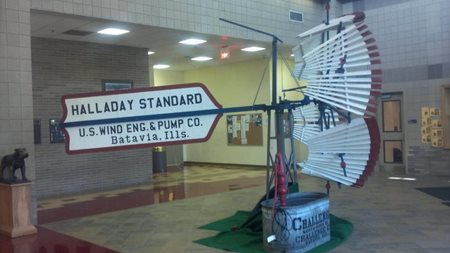 The Halladay Standard was manufactured by the U.S. Wind Engine and Pump Company from the 1860s to the 1920s. It was the first commercially successful American windmill that could control its own speed of operation. Photo: BataviaHistory.org
Another windmill refinement was also born in Batavia but wasn’t initially used there. As the story goes, former USWE employee Thomas O. Perry was a mechanical engineer who conducted exhaustive experiments to invent metal-bladed windmills that were reportedly 87 percent more efficient than the wooden-bladed windmills of the day.
The Halladay Standard was manufactured by the U.S. Wind Engine and Pump Company from the 1860s to the 1920s. It was the first commercially successful American windmill that could control its own speed of operation. Photo: BataviaHistory.org
Another windmill refinement was also born in Batavia but wasn’t initially used there. As the story goes, former USWE employee Thomas O. Perry was a mechanical engineer who conducted exhaustive experiments to invent metal-bladed windmills that were reportedly 87 percent more efficient than the wooden-bladed windmills of the day.
Although Perry perfected the final galvanized steel configuration at USWE, he could not convince conservative management to use his findings. So, Perry and LaVerne Noyes left USWE around 1883 and started Aermotor Windmill Company in Chicago, which is still in operation today in San Angelo, Texas. Aermotor introduced the metal windmill, which was a huge success and further advanced the industry.
But the current Batavia City Hall is housed in the building that was originally the Appleton Manufacturing Company, one of the large windmill builders in Batavia. And no one can deny that the windmill industry is a major part of the city’s history.
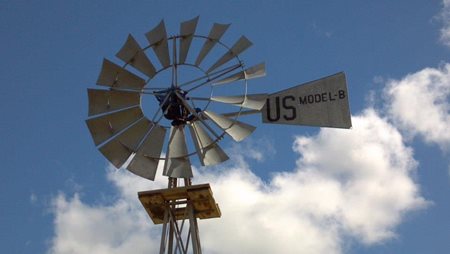 The Model B windmill was manufactured by the U.S. Wind Engine and Pump Company from 1912 to the 1920s. This mill was designed for use on ranches, so it was built to withstand strong winds. Photo: BataviaHistory.org
“We wanted to make sure we held onto this history because people are interested in it,” said Schielke, who’s been the mayor for 45 years. “To me, it’s fascinating. I’ve lived here all my life, and now I’m 77 years old, and a lot of old-time Batavians still recall when grandpa worked at the windmill factory. It was a big thing.”
The Model B windmill was manufactured by the U.S. Wind Engine and Pump Company from 1912 to the 1920s. This mill was designed for use on ranches, so it was built to withstand strong winds. Photo: BataviaHistory.org
“We wanted to make sure we held onto this history because people are interested in it,” said Schielke, who’s been the mayor for 45 years. “To me, it’s fascinating. I’ve lived here all my life, and now I’m 77 years old, and a lot of old-time Batavians still recall when grandpa worked at the windmill factory. It was a big thing.”
For John Dillon, former water and sewer superintendent for the city of Batavia, maintaining the restored windmills was part of his job for many years. “I got involved more after Bob [Popeck] retired,” Dillon said. Popeck was also a city employee, and he had the idea to assemble the collection of self-regulating windmills and bring them back to Batavia in 1994.
“Bob found them, searched out people that could restore them, and got them installed around town,” Dillon said. “When Bob was getting ready to retire, he knew I had some interest in Batavia history.” So, Popeck asked Dillon to keep the windmills in good working order.
Another Engineering Landmark: Engineering Chattanooga’s 130-Year-Old Incline Railway
Dillon and other city employees did routine maintenance on the windmills, such as painting and greasing them. He and his team were also involved in some bigger restoration jobs when needed.
“We restored two or three of them pretty comprehensively. But most of that involved some help from outside professional windmill contractors who were really knowledgeable about the details of the windmills,” Dillon said. “They would cut all the wood exactly as needed in their shop and then ship it to us. Then we would take the old parts off and put the new parts on.”
Dillon is fascinated by the windmills as well as their evolution into today’s wind turbines.
“Bottom line, yesterday’s windmills and today’s wind turbines are considered a source of power,” he said. “They harness the power of the wind. Wind turbines are designed to provide electricity, but they’re the modern version of the old 1800s windmills. They provide the power, either water or wind. It’s funny how clean energy’s always been there, and it’s come full circle.”
Claudia Hoffacker is an independent writer in Minneapolis.
And a big part of the American windmill story took place in the small Illinois town of Batavia. A western suburb of Chicago with a current population of about 26,000, Batavia adopted the nickname “Windmill City” because it was home to six windmill manufacturing companies from the 1860s to the 1950s.
Today, Batavia visitors can see a collection of the windmills that were built there. They are displayed near the Batavia Government Center and along the Fox River. As part of a community project initiated by the late Bob Popeck in 1994, 17 windmills were brought back to Batavia and restored to create the display. This windmill collection was named an ASME Historic Mechanical Engineering Landmark in September 2013.
A brief history
In the mid-1800s, the rapid expansion of the U.S. railway system was underway, requiring water to supply the steam engines. In addition, ranchers in the arid west needed a way to draw water from the ground. Windmills were critical to meet these needs and, as a result, the windmill industry took off.Connecticut native Daniel Halladay was a leader in the advancement of windmills. His patented invention of the self-regulating wind engine in 1854 revolutionized the industry and inspired the launch of many windmill companies.
The Halladay Vaneless was manufactured by the U.S. Wind Engine and Pump Company from 1880 to 1890. The Challenge Vaneless model 1913 was manufactured in 1913 by the Challenge Company. Photo: BataviaHistory.org
In the years after USWE set up shop, five other windmill manufacturers of various sizes opened in Batavia. The major ones were USWE, Challenge Wind Mill & Feed Mill Company, and Appleton Manufacturing Company. The three smaller companies were Batavia Wind Mill Company, Snow Manufacturing Company, and Danforth Windmill Company. By 1951, all the companies had closed, as electric water pumps had largely replaced windmill water pumps by that time.
But in the 1880s, Halladay’s self-regulating windmills could be seen on farms all over the Midwest and the West, where the technology was used to pump water for livestock, crops, and more. They were also popping up along railroad tracks, where water towers and windmills were needed about every 20 miles to refill the water tanks of steam locomotives.
More for You: The Old Mill Grinds On
“Self-regulating” meant the windmill would automatically turn its four variable-pitch blades away from a strong wind, rather than spinning so fast that centrifugal acceleration would destroy it. “The ingenious mechanical design of the wind-engine system of gears and linkages made efficient use of centrifugal and gravitational forces in controlling the windmill blades’ resistance to air flow by automatically adjusting blade orientation to the wind to provide nearly constant wheel speed in variable air velocities,” according to an ASME brochure about the Batavia windmills that was released for the landmark ceremony in 2013.
The Halladay Standard was manufactured by the U.S. Wind Engine and Pump Company from the 1860s to the 1920s. It was the first commercially successful American windmill that could control its own speed of operation. Photo: BataviaHistory.org
Although Perry perfected the final galvanized steel configuration at USWE, he could not convince conservative management to use his findings. So, Perry and LaVerne Noyes left USWE around 1883 and started Aermotor Windmill Company in Chicago, which is still in operation today in San Angelo, Texas. Aermotor introduced the metal windmill, which was a huge success and further advanced the industry.
Bringing the windmills home
Today, Batavia still calls itself the Windmill City, even though, as Mayor Jeffery Schielke admits, all the people who worked on the windmills are gone.But the current Batavia City Hall is housed in the building that was originally the Appleton Manufacturing Company, one of the large windmill builders in Batavia. And no one can deny that the windmill industry is a major part of the city’s history.
The Model B windmill was manufactured by the U.S. Wind Engine and Pump Company from 1912 to the 1920s. This mill was designed for use on ranches, so it was built to withstand strong winds. Photo: BataviaHistory.org
For John Dillon, former water and sewer superintendent for the city of Batavia, maintaining the restored windmills was part of his job for many years. “I got involved more after Bob [Popeck] retired,” Dillon said. Popeck was also a city employee, and he had the idea to assemble the collection of self-regulating windmills and bring them back to Batavia in 1994.
“Bob found them, searched out people that could restore them, and got them installed around town,” Dillon said. “When Bob was getting ready to retire, he knew I had some interest in Batavia history.” So, Popeck asked Dillon to keep the windmills in good working order.
Another Engineering Landmark: Engineering Chattanooga’s 130-Year-Old Incline Railway
Dillon and other city employees did routine maintenance on the windmills, such as painting and greasing them. He and his team were also involved in some bigger restoration jobs when needed.
“We restored two or three of them pretty comprehensively. But most of that involved some help from outside professional windmill contractors who were really knowledgeable about the details of the windmills,” Dillon said. “They would cut all the wood exactly as needed in their shop and then ship it to us. Then we would take the old parts off and put the new parts on.”
Dillon is fascinated by the windmills as well as their evolution into today’s wind turbines.
“Bottom line, yesterday’s windmills and today’s wind turbines are considered a source of power,” he said. “They harness the power of the wind. Wind turbines are designed to provide electricity, but they’re the modern version of the old 1800s windmills. They provide the power, either water or wind. It’s funny how clean energy’s always been there, and it’s come full circle.”
Claudia Hoffacker is an independent writer in Minneapolis.
Six companies in Batavia, Ill., built the windmills that pumped water for the American West. A collection of 17 restored windmills is a Historic Mechanical Engineering Landmark.

Independent writer and editor
Related Content

Oct 14, 2026
How Glass Is Quietly Shaping the Future of Automotive Engineering
Oct 12, 2026
From Disruption to Optimization: The Role of Simulation in Modern Refining
Digital simulation is helping refiners improve efficiency, troubleshoot operational challenges, and adapt to an increasingly complex energy landscape.

Oct 12, 2026
Podcast: Standards as the Backbone of Nuclear & Fusion Energy
Lester Su and Dale Matthews explore how codes and standards support quality and innovation as nuclear and fusion technologies continue to advance.

Oct 7, 2026
Better Listening Builds Better Careers


For engineers, better listening can reveal critical information, strengthen trust, and lead to smarter decisions.