Flying Cars Speed Toward Mass Production
Flying Cars Speed Toward Mass Production
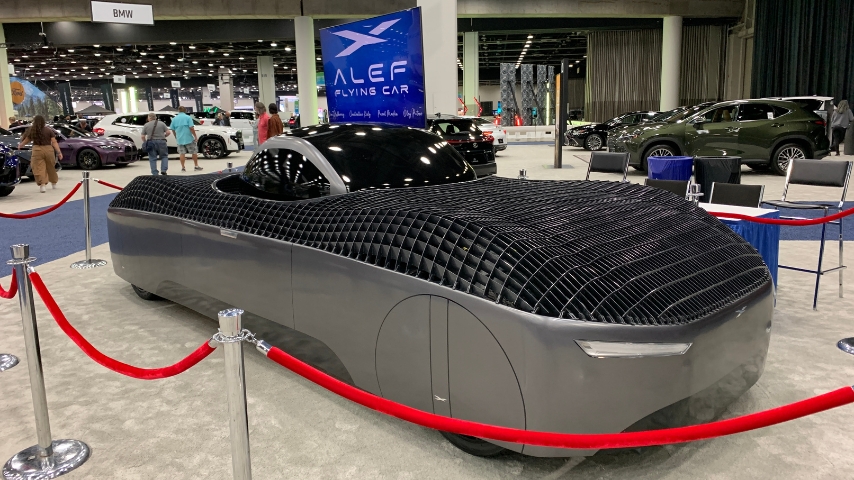
Alef Aeronautics combines electric hub engines and propellers to alternate between the roads and skies.
Imagine if your car could bypass a stressful gridlock or commute by simply lifting into the skies. This is the vision of Alef Aeronautics, which has launched the first drive-and-fly vehicle. With a combination of electric engines and propellers, the car has a projected range of 200 road miles and 110 miles for flights. The technology could alleviate traffic congestion while providing a soaring transportation experience.
“Everyone loves flying cars in science fiction movies. But we’re not trying to build something because it’s cool—we want to solve real problems that are happening today,” explained Constantine Kisly, Alef’s director of engineering and co-founder.
Commuting is a costly activity. The average time for a one-way trip is roughly 27 minutes, according to 2024 data by the U.S. Census Bureau. Over 9 percent of workers even have a one-way commute of 60 minutes or more. Getting to work can occupy a precious portion of daily life.
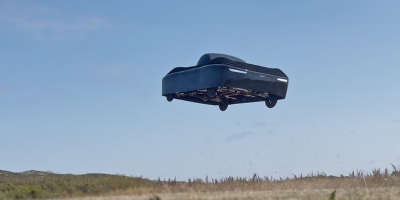 Flight is achieved with a distributed electric propulsion system of eight propellers. Photo: Alef Aeronautics
“Traffic is a problem we have yet to solve. Cities and populations are growing, so it’s an issue that’s only getting worse,” Kisly argued. “The traditional solutions are to go underground with more subways or expand over the ground by adding more lanes and public transportation. Alef’s approach is to go above the ground instead.”
Flight is achieved with a distributed electric propulsion system of eight propellers. Photo: Alef Aeronautics
“Traffic is a problem we have yet to solve. Cities and populations are growing, so it’s an issue that’s only getting worse,” Kisly argued. “The traditional solutions are to go underground with more subways or expand over the ground by adding more lanes and public transportation. Alef’s approach is to go above the ground instead.”
Founded in 2015, Alef has now graduated to production on its Model A Ultralight. The car’s body was unveiled at a 2023 CNET event, the same year Alef secured a Special Airworthiness Certification from the Federal Aviation Administration (FAA). Brief test footage by NBC News in early 2025 shows it successfully lifting off, soaring over a parked SUV and landing.
Engineering a flying car faces a steep challenge—blending automobile and plane mechanics into a single body, not to mention satisfying all the associated regulations for each. The movie magic seen in “Blade Runner” and “The Fifth Element” doesn’t have to reckon with the laws of gravity, the Department of Transportation or the FAA.
“Our main challenge is how to marry driving and flying together,” Kisly said. “There’s a lot of material science that are contradictions. To fulfill the use case, we have to get the functionality, geometry, and commuter range all aligned.”
To achieve flight, the car must lift off the ground and then thrust forward. Yet all of this is achieved without side wings, a tail, or jet fuel.
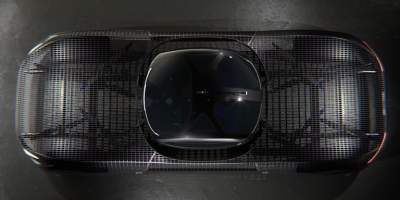 The dimensions of Alef’s Model A are intentionally compatible with existing roads and parking spaces. Photo: Alef Aeronautics
“Forward flight is a key point to this project because there is a change in aerodynamic forces when shifting from vertical to horizontal flight,” Kisly stressed.
The dimensions of Alef’s Model A are intentionally compatible with existing roads and parking spaces. Photo: Alef Aeronautics
“Forward flight is a key point to this project because there is a change in aerodynamic forces when shifting from vertical to horizontal flight,” Kisly stressed.
Alef uses eight propellers placed evenly throughout the body. This distributed electric propulsion system places the Model A within the vertical take-off and landing (eVTOL) aircraft category. Liftoff takes place within 30-60 seconds, minus safety checklists.
For long flights, the car will rotate sideways. The right and left sides will serve as wings, leveraging the same principles as biplanes. The cabin will stabilize thanks to a gimbal mechanism, transforming the driver’s seat into a cockpit.
One of the most intriguing use cases is what Alef calls “the hop scenario.”
“This is for short distances under a few miles, like many basic errands. You can lift off from your driveway, fly to a grocery store or restaurant and land in the parking lot,” Kisly said.
The company stresses safety at every turn, emphasizing there are zero single points of failure through octuple redundancy and features like ballistic parachutes, obstacle detection, and motor failure glide. Operators will also need to adhere to the FAA’s compliance program.
Alef’s drive mode is powered by four electric hub engines attached to the wheels. The Model A is categorized as a low-speed vehicle per the National Highway Traffic and Safety Association, designated for roads that are no more than 35 mph and a maximum travel speed of 25 mph. A step above golf carts, this puts it on par with street-legal utility vehicles or hospitality guest haulers.
 The top of the carbon fiber body has a grille mesh for airflow. The overall look is evocative of the Bell helicopter, recognizable to “M*A*S*H” fans, with 1960s vibes reminiscent of the Batmobile and Aston Martins. Concept drawings indicate it will have scissor doors that open upwards. No interior footage was available at press time.
The company is already taking pre-orders for the Model A, which has an expected price tag of $300,000. This investment is on par with luxury vehicles like Bentley or beginner Lamborghinis, though it remains miles away from seven-figure supercars like Bugatti, McLaren, or Lotus.
The ultimate goal is to have an affordable four-seat model competitive with a compact car, which will be achievable when the startup can scale into mass production. Alef also hopes to deliver an autonomous version, freeing passengers to lean back and enjoy the view.
Jennie Morton is an engineering and construction writer based in Iowa.
“Everyone loves flying cars in science fiction movies. But we’re not trying to build something because it’s cool—we want to solve real problems that are happening today,” explained Constantine Kisly, Alef’s director of engineering and co-founder.
Taming traffic trouble
Commuting is a costly activity. The average time for a one-way trip is roughly 27 minutes, according to 2024 data by the U.S. Census Bureau. Over 9 percent of workers even have a one-way commute of 60 minutes or more. Getting to work can occupy a precious portion of daily life.
Flight is achieved with a distributed electric propulsion system of eight propellers. Photo: Alef Aeronautics
Founded in 2015, Alef has now graduated to production on its Model A Ultralight. The car’s body was unveiled at a 2023 CNET event, the same year Alef secured a Special Airworthiness Certification from the Federal Aviation Administration (FAA). Brief test footage by NBC News in early 2025 shows it successfully lifting off, soaring over a parked SUV and landing.
Engineering a flying car faces a steep challenge—blending automobile and plane mechanics into a single body, not to mention satisfying all the associated regulations for each. The movie magic seen in “Blade Runner” and “The Fifth Element” doesn’t have to reckon with the laws of gravity, the Department of Transportation or the FAA.
“Our main challenge is how to marry driving and flying together,” Kisly said. “There’s a lot of material science that are contradictions. To fulfill the use case, we have to get the functionality, geometry, and commuter range all aligned.”
Flights of fancy
To achieve flight, the car must lift off the ground and then thrust forward. Yet all of this is achieved without side wings, a tail, or jet fuel.
The dimensions of Alef’s Model A are intentionally compatible with existing roads and parking spaces. Photo: Alef Aeronautics
Alef uses eight propellers placed evenly throughout the body. This distributed electric propulsion system places the Model A within the vertical take-off and landing (eVTOL) aircraft category. Liftoff takes place within 30-60 seconds, minus safety checklists.
For long flights, the car will rotate sideways. The right and left sides will serve as wings, leveraging the same principles as biplanes. The cabin will stabilize thanks to a gimbal mechanism, transforming the driver’s seat into a cockpit.
One of the most intriguing use cases is what Alef calls “the hop scenario.”
“This is for short distances under a few miles, like many basic errands. You can lift off from your driveway, fly to a grocery store or restaurant and land in the parking lot,” Kisly said.
The company stresses safety at every turn, emphasizing there are zero single points of failure through octuple redundancy and features like ballistic parachutes, obstacle detection, and motor failure glide. Operators will also need to adhere to the FAA’s compliance program.
A comfortable cruise
Alef’s drive mode is powered by four electric hub engines attached to the wheels. The Model A is categorized as a low-speed vehicle per the National Highway Traffic and Safety Association, designated for roads that are no more than 35 mph and a maximum travel speed of 25 mph. A step above golf carts, this puts it on par with street-legal utility vehicles or hospitality guest haulers.
5 Fantastic Technologies That We Still Don’t Have
It isn’t just the flying car. Some longstanding tropes of 20th century science fiction are still on the launch pad.
The company is already taking pre-orders for the Model A, which has an expected price tag of $300,000. This investment is on par with luxury vehicles like Bentley or beginner Lamborghinis, though it remains miles away from seven-figure supercars like Bugatti, McLaren, or Lotus.
The ultimate goal is to have an affordable four-seat model competitive with a compact car, which will be achievable when the startup can scale into mass production. Alef also hopes to deliver an autonomous version, freeing passengers to lean back and enjoy the view.
Jennie Morton is an engineering and construction writer based in Iowa.
Alef Aeronautics combines electric hub engines and propellers to alternate between the roads and skies.

Freelance writer based in Iowa
Related Content


Apr 13, 2026
ASME Announces Platinum Sponsorship of Dartmouth’s Formula Hybrid + Electric Competition
Apr 13, 2026
The Birth of Practical Aviation

The seconds-long flight at Kitty Hawk was not the Wright brothers’ most impressive accomplishment.


Apr 10, 2026
Quiz: The Engineer’s Obsolete Toolkit
See what you know about apparatuses and devices that helped engineers do their jobs before computers.

Apr 9, 2026
From Mechanical Engineer to Cobbler

Alex Stanzel went from manufacturing and quality engineering to resoling footwear and handcrafting custom shoes—then brought millions along for the ride on TikTok.